Lagotto Romagnolo Separation Anxiety: Signs, Causes and Proven Solutions.
You leave the house for forty minutes. You come back to find a couch cushion destroyed, your Lagotto Romagnolo trembling by the door, and a neighbor’s voicemail mentioning non-stop barking. Sound familiar? If you are a Lagotto Romagnolo owner dealing with a dog that cannot seem to cope when you walk out the door, you are not imagining things and you are not alone.
Separation anxiety is one of the most commonly reported behavioral challenges in the Lagotto Romagnolo breed. It is not a character flaw, a sign of poor training, or evidence that you made the wrong choice of dog. It is a deeply rooted response to the Lagotto’s nature as a breed built for constant closeness with its working partner, and understanding that nature is the first step toward genuinely helping your dog.
This guide covers everything you need to know about separation anxiety in the Lagotto Romagnolo: what it actually is, why Lagottos are particularly prone to it, how to tell the difference between true separation anxiety and normal boredom behavior, and the most effective evidence-based strategies for helping your dog feel safe and calm when you are not there.
What Is Separation Anxiety in Dogs?
Separation anxiety is a clinical behavioral condition in which a dog experiences significant distress when separated from the person or people they are most attached to. It is not simply a dog that prefers company or gets a bit restless when alone. True separation anxiety involves a genuine stress response that begins the moment a dog anticipates being left alone, often before the owner has even reached the door.
The distinction matters because the treatment for true separation anxiety is different from the management of boredom or mild attention-seeking behavior. Understanding where your Lagotto falls on that spectrum guides the approach you take.
Separation Anxiety vs. Boredom and Frustration
A Lagotto Romagnolo that chews furniture, gets into the trash, or barks occasionally when alone is not necessarily experiencing separation anxiety. These behaviors may simply reflect insufficient exercise, insufficient mental stimulation, or the predictable consequences of leaving an intelligent, active breed alone without enough to do.
True separation anxiety looks different. The distress begins before departure, often triggered by cues like picking up keys, putting on shoes, or reaching for a coat. The behavior during your absence is intense and persists throughout the time you are gone rather than stopping after a few minutes. And when you return, your dog’s greeting is often frantic and prolonged rather than simply happy.
Anxiety-driven behaviors are rooted in panic. Boredom-driven behaviors are rooted in opportunity. Both need addressing, but they need addressing differently.
Why Are Lagotto Romagnolos Prone to Separation Anxiety?
Not every breed develops separation anxiety at the same rate, and some breeds are significantly more predisposed than others. The Lagotto Romagnolo sits comfortably in the higher-risk category for several breed-specific reasons.
A History of Close Partnership
The Lagotto Romagnolo was developed over centuries in the Romagna region of northern Italy, first as a water-retrieving dog and later as a highly specialized truffle-hunting companion. In both roles, the breed worked in close, constant partnership with a single handler. The dog and the person operated as a unit. This is not incidental to the Lagotto’s history. It is the entire foundation of how the breed was selected and developed over generations.
The result is a dog with an unusually deep attunement to human presence and human emotion. Lagottos read their owners with remarkable accuracy. They notice subtle changes in routine, mood, and body language that most other breeds would miss entirely. This emotional sensitivity is one of the qualities that makes them exceptional companions and relatively easy to train. It is also what makes them more susceptible to distress when that human presence is suddenly absent.
High Intelligence and Emotional Depth
Highly intelligent breeds are often more emotionally complex, and the Lagotto Romagnolo is no exception. A dog with a rich inner life processes separation differently from a breed that is more self-contained and independent. The Lagotto’s capacity for deep emotional bonding means the absence of their person is experienced acutely, not as a minor inconvenience but as a significant disruption to their sense of security and wellbeing.
The Socialization Factor
Many cases of separation anxiety in Lagotto Romagnolos are rooted at least partly in inadequate early socialization to being alone. Breeders and new owners who are home constantly during the puppy’s first weeks sometimes inadvertently create a puppy that has never had the chance to practice being calm by itself. A puppy that is always in physical contact with a person during the critical development window may genuinely not know how to self-regulate when that contact is withdrawn.
This does not mean constant puppy companionship causes anxiety. It means that teaching a puppy how to be alone is just as important as any other training task, and it is one that is very easy to overlook when you are in the delightful haze of early puppy ownership.
The Post-Pandemic Effect
Separation anxiety has become significantly more common across all breeds since 2020, and the Lagotto Romagnolo community is no exception. Millions of dogs were brought home during periods of extended remote work and reduced social activity, which meant they spent their entire developmental period in nearly constant human company. When owners returned to offices and normal life schedules, many of these dogs encountered true solo time for the first time and responded with significant distress.
If your Lagotto was a pandemic puppy or was raised during a period of unusual closeness, this context may be directly relevant to what you are experiencing now.
Signs of Separation Anxiety in the Lagotto Romagnolo
Recognizing the signs of separation anxiety is important because some of them are easy to miss if you are not home to witness them directly. Many owners discover their Lagotto has separation anxiety only when a neighbor mentions the barking, when they set up a camera while away, or when they come home to visible destruction.
Before You Leave
Pre-departure anxiety often begins with your getting-ready routine. Your Lagotto Romagnolo may start following you more closely than usual, become restless or agitated, begin panting without physical exertion, refuse to settle in their usual spot, or pace between rooms as your departure cues stack up.
Some Lagottos learn departure cues so precisely that putting on a specific jacket or picking up your work bag causes an immediate visible shift in their behavior. This pre-departure distress is one of the clearest indicators of true anxiety rather than simple boredom.
While You Are Away
If you have not already set up a camera to observe your Lagotto while you are out, this is one of the most valuable things you can do. What you observe in your absence is far more informative than what you see at homecoming.
Common behavioral signs during the absence include sustained barking, howling, or whining that does not diminish over time. A bored or frustrated dog typically vocalizes for a period and then settles. An anxious dog may continue vocalizing throughout your absence or repeat cycles of distress separated by brief settling periods.
Other signs include destructive behavior concentrated near exits such as doors and windows, through which the dog is attempting to follow you or reach you. House training regression, in which a fully trained dog urinates or defecates indoors only when alone, is a very common sign of anxiety that owners sometimes misinterpret as spite or stubbornness. Excessive salivation, self-directed behaviors like paw licking or flank biting, and in severe cases complete refusal to eat or drink while alone are also indicators of significant distress.
When You Return
The reunion greeting tells part of the story. A dog that greets you with prolonged, frantic excitement that takes more than a few minutes to settle is displaying a level of arousal that suggests real distress during your absence. While it is natural to feel flattered by an enthusiastic greeting, an extremely frantic reunion response often reflects how intensely your absence was felt rather than simply how much your dog loves you.
Diagnosing Separation Anxiety: Getting It Right
Before beginning any treatment plan, it is worth taking time to properly identify what you are dealing with. Not all alone-time behavior is separation anxiety, and the distinction affects which interventions will actually work.
Set Up a Camera
The most informative thing you can do is install a basic pet camera or position a phone or tablet to record your Lagotto’s behavior during a short departure. Leave for thirty minutes, review the footage, and note exactly when distress behaviors begin, whether they escalate or plateau, and how long they persist. This gives you an accurate baseline rather than assumptions about what your dog does when you are not there.
Consult a Veterinarian
If the footage confirms significant distress, book a veterinary appointment before diving into behavioral training. True separation anxiety has a physiological component. The dog is experiencing real fear and stress, and in moderate to severe cases, behavioral modification alone may not be sufficient. Your veterinarian may discuss anti-anxiety medications or supplements that reduce the physiological stress response enough to allow behavioral training to take effect. Medication in this context is not a crutch. It is a tool that creates the neurological conditions in which learning can happen.
Consider a Veterinary Behaviorist or Certified Trainer
For moderate to severe separation anxiety, working with a certified applied animal behaviorist or a certified professional dog trainer with documented experience in separation anxiety is strongly recommended. Separation anxiety is a complex behavioral condition, and generic training advice applied incorrectly can sometimes make it worse. A specialist can create a personalized desensitization protocol based on your dog’s specific triggers and threshold.
Proven Solutions for Lagotto Romagnolo Separation Anxiety
Treatment for separation anxiety is not fast. It requires patience, consistency, and the willingness to move at your dog’s pace rather than your own timeline. The following strategies reflect the current evidence base in veterinary behavioral medicine and are applicable to Lagotto Romagnolos at any life stage, though starting early with puppies produces faster results.
1. Prevention: Teaching Puppies to Be Alone
If you have a Lagotto Romagnolo puppy, the most important thing you can do is build solitude tolerance from the very first week. This does not mean leaving your puppy alone for hours. It means intentionally and regularly creating brief, positive experiences of being alone so that solitude is normalized early.
Place your puppy in a comfortable crate or exercise pen with a food-stuffed toy while you are home but in a different room. Build from one minute to two minutes to five minutes over the course of days. Your puppy should be calm or engaged with their toy during these sessions, not distressed. This builds the foundational experience that being alone is safe, predictable, and temporary.
As your puppy grows, gradually increase solo time while you are home before ever leaving the house entirely. A puppy that can settle calmly in its crate for thirty minutes while you work in another room is significantly better prepared for your first true departure than one that has never practiced solitude at all.
2. Departure Desensitization
For dogs already experiencing anxiety, the departure routine itself becomes a trigger. The way to address this is through systematic desensitization: repeatedly exposing your Lagotto to departure cues at very low intensity until they stop predicting the feared outcome.
Put on your shoes and sit back down. Pick up your keys, set them down, watch TV. Touch the door handle and walk away. Repeat these actions dozens of times throughout the day without actually leaving. Over time, these cues lose their predictive power and your dog’s physiological stress response to them diminishes.
This process takes days to weeks depending on the dog’s current sensitivity level. It must be done consistently and with genuine commitment to the repetitions required. Occasional practice has minimal effect. Daily, frequent repetition is what shifts the conditioned response.
3. Graduated Alone Time Training
The core of separation anxiety treatment is a structured protocol in which the dog is gradually exposed to increasingly longer departures, always at or just below the threshold of noticeable distress. This is not the same as simply leaving your dog for longer periods and hoping they adjust. Graduated exposure requires you to identify your dog’s precise threshold and work just within it.
Begin with departures your Lagotto can handle without distress. For some dogs, this means walking to the mailbox and returning. For others, it means stepping outside the door for ten seconds. The exact starting point does not matter. What matters is starting below the anxiety threshold and building incrementally.
Increase the departure duration only when your dog is consistently calm at the current level. A useful working goal is to add no more than thirty seconds per training step and to return before any visible distress begins. Returning to a distressed dog teaches nothing useful. Returning to a calm dog reinforces that departures end safely.
Use a camera to monitor your Lagotto during training departures. You are looking for a dog that settles within the first two to three minutes and remains relaxed until your return.
4. Enrichment and Pre-Departure Exercise
A Lagotto Romagnolo that is mentally and physically tired before a departure copes significantly better than one that is fully energized. This does not solve true separation anxiety on its own, but it meaningfully reduces the intensity of distress and makes behavioral training more effective.
Exercise your Lagotto thoroughly before any planned departure. A long walk, a scent work session, or a session with a snuffle mat or puzzle feeder depletes the physical and mental energy that would otherwise fuel anxiety behaviors. For the Lagotto specifically, scent-based enrichment is particularly powerful. A twenty-minute nose work session in the yard or a scatter feed in the grass tires a Lagotto more thoroughly than a forty-minute walk.
Provide a high-value food toy exclusively during departures. A frozen Kong stuffed with your Lagotto’s favorite food, available only when you leave, creates a positive association with departure and gives your dog something absorbing to do during the first, most vulnerable minutes of your absence.
5. Crate Training as a Safety Cue
For some Lagotto Romagnolos, a properly introduced crate becomes a genuine safe space that reduces anxiety by creating a predictable, den-like environment during absences. A crate that is associated with calm, positive experiences and used consistently as the departure location can reduce anxiety by providing a familiar, bounded space rather than the overwhelming full freedom of an empty house.
However, crate training only reduces anxiety for dogs that have a genuinely positive association with the crate. A dog that finds the crate aversive and is confined in it during departures will experience compounded distress. Build crate positivity long before using it as an alone-time tool, and monitor your dog’s crate behavior on camera before assuming it is helping.
6. Scent-Based Comfort Tools
The Lagotto Romagnolo’s extraordinary nose makes scent a particularly powerful tool for comfort. Leaving an unwashed item of clothing with your scent in your dog’s resting area has been shown to reduce stress indicators in dogs during owner absence. The garment should be unwashed so the scent is recent and strong, and it should be placed somewhere your dog naturally settles, not in the crate if the crate association is not yet solid.
Dog-appeasing pheromone products, sold under brand names like Adaptil, release a synthetic version of the pheromone produced by nursing mothers. Available in diffuser, collar, and spray formats, these products have mixed but generally positive evidence for reducing anxiety-related behavior in dogs. They work best as a complement to behavioral training rather than a standalone solution.
7. Consistency in Daily Structure
Lagotto Romagnolos are highly attuned to routine. A predictable daily schedule reduces the uncertainty that amplifies anxiety. When departures happen at the same time of day, are preceded by the same sequence of events, and end with a consistent return pattern, the dog develops a clearer internal model of what is happening and when it will end. Unpredictability is fuel for anxiety. Routine is its antidote.
What Not to Do When Your Lagotto Has Separation Anxiety
Do not punish anxiety-related behavior. Chewed furniture and indoor accidents that occur during anxious alone time are not deliberate acts of defiance. They are the behavioral output of a dog in a genuine stress state. Punishing these behaviors after the fact teaches your Lagotto nothing about what to do differently and may increase overall anxiety levels.
Do not get another dog to solve the problem. Separation anxiety is specifically about the absence of the attached human, not simply about being alone. A second dog in the home may reduce boredom-related behavior but rarely resolves true separation anxiety. Introducing a second dog to solve anxiety can also create new challenges if the relationship between the two dogs does not develop well.
Do not make departures and arrivals emotionally dramatic. Long, emotional goodbyes heighten your dog’s awareness that something significant is happening and amplify the stress response. Brief, calm, matter-of-fact departures and low-key greetings on return reduce the emotional charge around these moments over time.
Do not expect overnight results. Separation anxiety develops over weeks and months. It resolves over weeks and months of consistent, methodical work. Progress is real but rarely linear, and there will be setbacks. The goal is a general trend toward improvement, not perfection by a specific date.
When to Seek Professional Help
If your Lagotto Romagnolo’s separation anxiety is causing significant distress to the dog, significant disruption to your household, or conflict with neighbors due to vocalization, professional support is not a last resort. It is the appropriate next step.
A veterinarian experienced in behavioral medicine can evaluate whether medication is appropriate as part of the treatment plan. In moderate to severe cases, a combination of medication and behavioral therapy is significantly more effective than behavioral therapy alone.
A certified separation anxiety trainer (CSAT) specializes specifically in this condition and uses video-based remote protocols to guide owners through graduated exposure programs tailored to their dog’s specific needs. This specialty certification exists because general dog training experience does not automatically translate to separation anxiety expertise.
Quick Reference Summary
| Symptom | Likely Cause | Response |
|---|---|---|
| Barking throughout entire absence | True separation anxiety | Graduated desensitization, veterinary consult |
| Destruction near doors and windows | Escape attempts driven by anxiety | Graduated departure training, enrichment |
| House training regression when alone | Anxiety-driven, not spite | Behavioral modification, possible medication |
| Settles after 10 to 15 minutes | Boredom or frustration, not anxiety | Increased exercise and enrichment |
| Frantic greeting lasting 10 plus minutes | Significant distress during absence | Camera monitoring, professional assessment |
| Pre-departure agitation and panting | Conditioned departure cue anxiety | Departure desensitization |
Frequently Asked Questions About Lagotto Romagnolo Separation Anxiety
Q: How long can a Lagotto Romagnolo be left alone? A healthy, well-adjusted adult Lagotto Romagnolo can typically handle being alone for four to six hours without significant distress, provided they have been properly conditioned to solitude, exercised beforehand, and given appropriate enrichment. Puppies under six months should not be left alone for more than two to three hours at a stretch. Dogs with active separation anxiety should not be left beyond their current distress threshold until that threshold has been systematically extended through training.
Q: Is separation anxiety more common in Lagotto Romagnolo puppies or adults? The foundations of separation anxiety are typically laid in puppyhood, either through inadequate solitude conditioning or through a significant stressful experience. However, the condition can also emerge or worsen in adult Lagottos following a major life change, such as a move, the loss of another pet in the household, a significant change in the owner’s schedule, or any prolonged period of unusually close contact followed by a sudden return to normal routine.
Q: Can a Lagotto Romagnolo with separation anxiety be cured? Many Lagotto Romagnolos with mild to moderate separation anxiety achieve full resolution through consistent behavioral training. Dogs with more severe anxiety often achieve significant improvement that allows for normal daily life, though some may require ongoing management. The word “cured” is less useful than “successfully managed,” and the goal is a dog that can be left alone comfortably for normal periods without distress, which is absolutely achievable in the great majority of cases.
Q: Will getting a second dog help my Lagotto’s separation anxiety? Rarely, and it depends entirely on the nature of the anxiety. If your Lagotto is attached specifically to you and becomes distressed in your absence, a second dog in the home will not resolve the anxiety because the problem is your absence, not aloneness in general. If your Lagotto is distressed simply by being without canine company and settles with another dog present, a companion may help. Camera monitoring while your Lagotto is alone with a resident dog is the only way to assess this accurately.
Q: My Lagotto only has accidents inside when I am gone. Is this separation anxiety? House training regression exclusively during owner absence is one of the most recognizable signs of separation anxiety in otherwise fully house-trained dogs. It is not spite, it is not a house training failure, and it cannot be resolved through reinforcing house training protocols alone. The underlying anxiety must be addressed. If your Lagotto is reliably clean when you are home but has accidents when alone, capture this on camera, note the context, and consult a veterinary professional.
Q: What medications are used for separation anxiety in dogs? The most commonly prescribed medications for separation anxiety in dogs include fluoxetine and clomipramine, both of which are approved by the FDA for use in dogs with this condition. Trazodone, alprazolam, and gabapentin may be used situationally or as adjuncts. These medications do not sedate the dog or make them passive. They reduce the intensity of the physiological anxiety response enough to allow behavioral learning to occur. Medication decisions should always be made by a veterinarian based on individual assessment, not general recommendation.
Concerned about separation anxiety before bringing home your Lagotto Romagnolo puppy? Our breeding program includes deliberate early socialization to solitude, handling, and varied environments so that every puppy we place has the strongest possible behavioral foundation from day one. Browse our available Lagotto Romagnolo puppies or reach out to our team to learn more about how we prepare our pups for real family life.
Lagotto Romagnolo Puppy Training: Your Complete Week-by-Week Guide for the First 3 Months
Bringing home a Lagotto Romagnolo puppy is one of the most exciting decisions you will ever make. But between the excitement of those curly ears and the reality of sleepless nights, it is easy to feel overwhelmed if you do not have a clear roadmap. The first three months with your Lagotto Romagnolo puppy are not just about survival. They are the single most important developmental window of your dog’s entire life. What happens during these twelve weeks will shape your puppy’s temperament, confidence, and relationship with the world for the next fifteen years.
This week-by-week Lagotto Romagnolo puppy training guide covers everything you need to know: what to expect each week, what to teach, what to watch for, and how to set your puppy up for success without the guesswork. Whether your Lagotto is arriving at eight weeks or twelve, this guide is built around the science of canine development and the very specific traits and needs of the breed.
Why the First 3 Months Matter So Much for Lagotto Romagnolo Puppies
Before diving into the weekly breakdown, it is worth understanding why this period is so critical specifically for the Lagotto Romagnolo.
The Lagotto is a highly intelligent, scent-driven working breed with deep sensitivity to human emotions and social dynamics. Unlike many other breeds, the Lagotto bonds intensely with its family and can develop anxiety or excessive caution if the critical socialization window, which runs roughly from three to sixteen weeks of age, is not used well. The flip side is equally true: a Lagotto puppy that is properly socialized, gently challenged, and consistently guided during these early weeks becomes an extraordinarily well-rounded, confident adult dog.
The other thing to understand is that Lagotto Romagnolo puppies are not blank slates. They arrive at your home already shaped by their first eight weeks with their breeder. A responsible breeder will have begun Early Neurological Stimulation from day three, introduced the puppies to household sounds, handled them daily, and given them varied surfaces and objects to explore. This head start matters enormously, and it is one of the reasons choosing a reputable Lagotto Romagnolo breeder is so important.
Before Your Puppy Comes Home: Weeks 1 and 2 of Preparation
Puppy-Proof Your Space
The Lagotto Romagnolo’s truffle-hunting instinct means they are natural explorers and diggers. Puppies will investigate every corner of your home at nose level, which means electrical cords, toxic houseplants, small objects, and accessible trash are genuine hazards. Do a low-to-the-ground walkthrough of every room your puppy will access and remove or secure anything within reach.
Install baby gates to limit access to stairs and certain rooms, especially during the first weeks when supervision is not constant. A puppy who learns to navigate a large home unsupervised too early is a puppy that learns bad habits without correction.
Set Up the Sleep Space
Your Lagotto Romagnolo puppy will sleep a great deal during the first weeks, often sixteen to eighteen hours a day. A crate, set up correctly, is not a punishment. It is a den, a place of safety, and one of the most valuable tools you have for house training and preventing destructive behavior during unsupervised moments.
Choose a crate that is large enough for your puppy to stand up, turn around, and lie down comfortably. Lagotto Romagnolos grow to about 24 to 35 pounds as adults, so a medium-sized crate works well. Place it in a low-traffic area of your bedroom for the first few weeks so your puppy can hear and smell you during the night. This dramatically reduces nighttime crying and helps your puppy feel secure in their new environment.
Add a soft blanket and, if your breeder agrees, a small piece of fabric from the litter to ease the transition.
Gather Your Supplies
Before your puppy arrives, make sure you have the following ready:
- Crate (medium, wire or plastic)
- Food and water bowls (stainless steel or ceramic, not plastic)
- Puppy-appropriate food matching what the breeder has been feeding, to avoid digestive upset
- Collar and ID tag with your phone number from day one
- Four to six-foot leash for early walks
- Slicker brush and wide-tooth comb to begin coat conditioning early
- Enzymatic cleaner for house training accidents
- Puppy-safe chew toys and a Kong or similar puzzle feeder
- Training treats (small, soft, and high-value)
Week 1: Arrival and Settling In (Usually Week 8 to 9 of Age)
What to Expect
Your Lagotto Romagnolo puppy has just left the only environment it has ever known: its mother, its littermates, and the sounds and smells of the breeder’s home. The first week is about one thing above all else: building trust. Do not rush training, do not invite friends over to meet the puppy immediately, and do not overwhelm your puppy with new experiences all at once.
Expect whining at night for the first two to five days. This is completely normal. Your puppy is not in distress. It is processing a profound change. Responding calmly, without making a big event of it, is the right approach. Placing a ticking clock near the crate can help simulate the sensation of a heartbeat.
Expect toileting accidents frequently. At eight weeks, a Lagotto Romagnolo puppy has essentially zero bladder control. They need to go outside after every meal, after every nap, after every play session, and roughly every forty-five minutes in between. This frequency decreases significantly with each passing week.
What to Do
Introduce the crate positively. Toss treats inside several times a day. Feed meals inside with the door open at first. Build a positive association before ever closing the door.
Begin a consistent daily rhythm. Wake-up time, feeding times, outside time, nap time, play time: a predictable schedule gives your Lagotto puppy the sense of security they need to settle quickly. Lagottos are creatures of routine and thrive with structure.
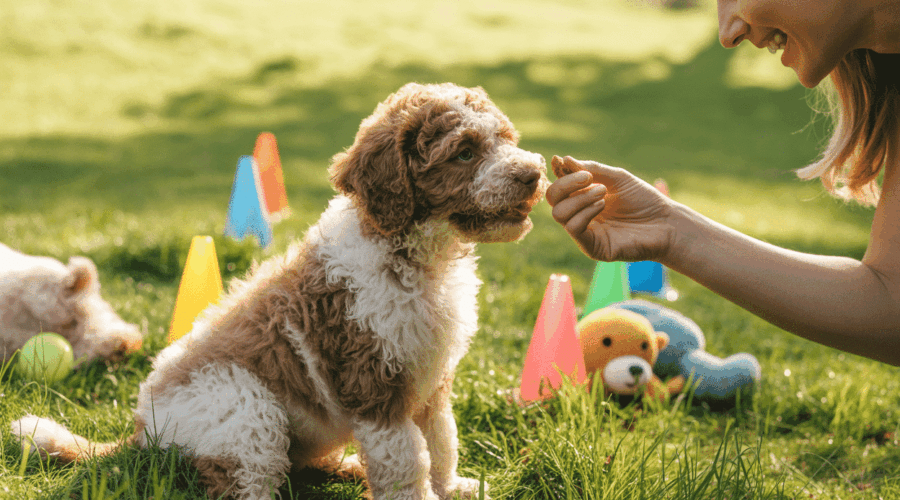
Start name recognition. Say your puppy’s name in a warm, upbeat tone and immediately offer a treat when they look at you. Do this twenty to thirty times a day. Name recognition is the foundation of every training behavior that follows.
Keep it calm. Limit visitors, limit noise, limit excitement. Your puppy needs rest and quiet bonding time far more than stimulation right now.
Training Focus This Week
- Name recognition
- Crate introduction
- House training foundations (going outside consistently)
- Learning the daily schedule
Week 2: Building the Foundation (Week 9 to 10 of Age)
What to Expect
By the second week, your Lagotto Romagnolo puppy will begin to relax noticeably. The constant alertness of week one gives way to genuine curiosity. You will see the first real signs of your puppy’s personality: which Lagottos are bold, which are more cautious, which ones immediately try to use their nose on every object in the house.
House training will begin to improve, though accidents are still frequent. Sleep at night is usually better by day seven or ten for most Lagotto puppies.
What to Do
Introduce the sit command. Hold a treat above your puppy’s nose and slowly move it backward toward their tail. As their bottom drops, say “sit” clearly and give the treat the instant they are sitting. Ten short repetitions twice a day is plenty. Lagottos learn fast, and by the end of this week most puppies are sitting reliably.
Begin crate closing sessions. Close the crate door for one to two minutes while you sit next to it. Offer a stuffed Kong to keep your puppy occupied. Gradually extend to five minutes by the end of the week. The goal is a puppy that settles happily, not one that panics.
Start touch desensitization. Gently handle your puppy’s ears, paws, mouth, and tail daily. Pair every touch with a small treat. This is not grooming. It is conditioning your puppy to associate handling with positive experiences. A Lagotto that tolerates ear cleaning, nail trimming, and professional grooming as an adult is one that was desensitized as a puppy.
Begin short indoor scent games. Hide a small treat under one of three cups and let your puppy sniff it out. Lagotto Romagnolo puppies have an extraordinary nose, and engaging it early channels their instinct productively.
Training Focus This Week
- Sit command
- Crate duration building
- Touch desensitization (ears, paws, mouth)
- Basic nose work introduction
Week 3: First Steps Into the World (Week 10 to 11 of Age)
What to Expect
This week marks the beginning of intentional socialization. The critical socialization window for dogs runs from approximately three to sixteen weeks of age. During this period, a puppy’s brain is biologically primed to form associations with new things: people, animals, sounds, environments, surfaces, and objects. Experiences encountered during this window become familiar and safe. Experiences missed during this window may become sources of anxiety later.
Because Lagotto Romagnolos can be naturally cautious with strangers and new situations, deliberately and positively exposing your puppy now prevents fearfulness in adulthood.
Before your puppy is fully vaccinated, focus on low-risk socialization: visiting friends’ homes with vaccinated dogs, carrying your puppy in safe public environments, and introducing them to different sounds and surfaces at home.
What to Do
Create a socialization list. Your goal by sixteen weeks is to have positively exposed your Lagotto puppy to as many of the following as possible:
- At least ten different people (men, women, children, people with hats, beards, or glasses)
- Other vaccinated dogs of different sizes
- Different floor surfaces: tile, wood, carpet, grass, gravel, and sand
- Different sounds: vacuum cleaner, hairdryer, traffic, thunder recordings, crowd noise
- Different environments: the car, a friend’s house, a pet-friendly store
- Handling by strangers: the vet, a groomer, a family friend
Each new experience must be positive. If your puppy shows fear, backing away with a low tail or showing whale eye, do not force the exposure. Move further away and let your puppy observe from a distance, offering treats for calm behavior. Progress at the puppy’s pace, not yours.
Introduce the “down” command. With your puppy sitting, lower a treat from their nose to the floor between their paws. As they follow it down, say “down” and reward when their elbows touch the floor. This one takes a few extra days for most puppies.
Training Focus This Week
- Active socialization (people, sounds, surfaces)
- Down command introduction
- Short car rides with positive associations
- Continuing sit and name recognition
Week 4: Expanding the Routine (Week 11 to 12 of Age)
What to Expect
Your Lagotto Romagnolo puppy is entering a confident, playful phase. Energy levels increase, coordination improves, and puppies begin to test limits. This is also when play biting tends to intensify. This is not aggression but normal puppy exploration through the mouth. The Lagotto, with its naturally soft mouth from its working heritage, is generally less prone to hard biting than many other breeds, but the behavior still needs to be redirected consistently.
House training should be showing real progress by now. Many Lagotto Romagnolo puppies begin to signal at the door by ten or eleven weeks if you have been consistent.
What to Do
Address play biting clearly. When your puppy bites your hand, say “ouch” in a calm, firm voice and immediately withdraw your attention for ten to fifteen seconds. Redirect to an appropriate toy. Never use your hands as play objects. Consistency from every family member is essential, because one person allowing biting while others correct it will confuse your puppy significantly.
Introduce “leave it.” Place a treat in your closed fist. When your puppy sniffs and mouths your hand and eventually backs away, open your hand. The moment they leave it, reward from your other hand. This command is among the most practically useful things you will ever teach your Lagotto.
Begin leash introduction indoors. Clip a lightweight leash to your puppy’s collar and let them drag it around the house for supervised sessions. Do not apply any pressure yet. The goal is simply making the leash a familiar, non-threatening object.
Extend crate time gradually. By week four, your Lagotto should be able to settle in the crate for one to two hours without distress during the day.
Training Focus This Week
- Play biting redirection
- “Leave it” command
- Leash familiarization
- Continued socialization push
Week 5: Leash Walking and Public Confidence (Week 12 to 13 of Age)
What to Expect
Depending on your veterinarian’s protocol and local vaccination schedule, many Lagotto puppies are cleared for limited outdoor public exposure by twelve to thirteen weeks. This opens up an entirely new world of socialization opportunities and marks a significant shift in your puppy’s development.
Bladder control continues to improve. Most Lagotto Romagnolo puppies at twelve weeks can hold their bladder for approximately two to three hours during the day, though the night may still require a single overnight trip outside.
What to Do
Begin leash walking outside. Walk on a loose leash at your puppy’s pace. When your Lagotto puppy moves ahead and the leash tightens, stop. Wait. The moment they return to your side or look up at you, mark it with “yes” and reward. Keep early walks short, around five to ten minutes. Lagotto puppies have developing joints and should not be pushed to walk long distances before four to five months of age.
Introduce a marker word or clicker. If you are not already using one, now is a great time to establish a consistent marker: either the word “yes” said briskly and clearly the instant a correct behavior occurs, or a clicker. The marker tells your Lagotto precisely which behavior earned the reward, dramatically accelerating learning.
Expose your puppy to real-world sounds outside. Traffic, cyclists, construction noise, and children playing are all valuable exposures. Watch your puppy’s reactions carefully. A Lagotto that freezes or tries to flee from sounds at twelve weeks needs more gradual desensitization now, not after the behavior is established.
Training Focus This Week
- Outdoor leash walking
- Marker training
- Real-world sound desensitization
- “Stay” introduction (one to two seconds initially)
Week 6: Recall, the Most Important Command (Week 13 to 14 of Age)
What to Expect
By week six at home, your Lagotto Romagnolo puppy should be settling into a genuine daily rhythm. Nights are usually reliable by now. House training accidents are increasingly rare with consistent management. The puppy’s personality is really beginning to emerge, and you will see their love of scent work, their affectionate nature with family, and their natural curiosity about the world.
What to Do
Make recall your obsession. The “come” command, also called a recall, is the most important safety skill your Lagotto Romagnolo will ever learn. Begin in a low-distraction environment. Call your puppy’s name followed by “come” in a bright, exciting tone. When they reach you, make it the best thing that has ever happened to them: a high-value treat, praise, and a brief play session. Never call your puppy to come to you for something they dislike, such as a bath or nail trim. Go to them instead. You are building the association that coming when called equals joy.
Practice recalls throughout the day, not just in formal training sessions. Call your puppy to come to their bowl, to come upstairs, and to come for a treat. Every successful recall reinforces the behavior.
Add a second location to your puppy’s known world. Take them to a friend’s yard, a park, or a pet-friendly shop. A Lagotto who only knows their own home can become anxious in unfamiliar environments as an adult.
Training Focus This Week
- Recall (come) command, practiced daily and extensively
- Expanding known environments
- Short “stay” duration building (five to ten seconds)
- Continued leash walking practice
Week 7: Adding Complexity (Week 14 to 15 of Age)
What to Expect
Your Lagotto Romagnolo puppy is growing fast. The puppy coat is still soft, but you may begin to notice the woolly adult texture emerging in patches, particularly on the back. Begin brushing more regularly, two to three times per week, to keep the coat mat-free and to continue desensitizing your puppy to grooming.
You may also notice a slight shift in focus and attention around this age. This is normal. Puppies around fourteen to fifteen weeks sometimes experience a secondary fear period and may suddenly seem cautious about things they previously accepted without concern. Do not force exposure. Respond with calm confidence and positive redirection.
What to Do
Introduce structured scent work. Place a specific scent, such as truffle oil on a cotton ball or a favorite treat, inside a small box with air holes among two or three identical empty boxes. Let your puppy sniff and indicate at the correct box by pawing or sniffing intently, then reward immediately. This is nose work training, and for Lagottos it is one of the most effective forms of mental stimulation available. A twenty-minute scent session tires your puppy more thoroughly than a one-hour walk.
Work on “place” or mat training. Point to a mat or bed and lure your puppy onto it. When all four paws are on the mat, mark and reward. Build duration slowly. A puppy who can settle on a mat on cue is a joy to have in restaurants, at friends’ homes, and in the car.
Begin introducing grooming tools properly. Turn on the clippers without putting them on your puppy. Reward for calmness. Touch the clippers to the coat briefly, then reward. The goal is a puppy who does not react to grooming equipment by adulthood, and that goal is built in small, calm sessions like these.
Training Focus This Week
- Structured scent work introduction
- “Place” or mat training
- Grooming tool desensitization
- “Stay” with mild distractions
Week 8: Impulse Control and Real-World Skills (Week 15 to 16 of Age)
What to Expect
By sixteen weeks, the critical socialization window is closing. This does not mean socialization stops. It should continue actively throughout your puppy’s first year. But the neurological plasticity that makes new experiences automatically acceptable is beginning to reduce. Whatever gaps exist at sixteen weeks will take more deliberate work to address later.
On the positive side, your Lagotto Romagnolo puppy at fifteen to sixteen weeks is showing real learning ability and retention. Commands taught in week two are solid. New ones are added in days rather than weeks.
What to Do
Practice impulse control through “wait.” Before placing your puppy’s food bowl down, hold it at knee height and ask your puppy to sit and wait. Lower the bowl slowly. If your puppy breaks the sit, raise the bowl again. Wait for the sit, then release with “okay.” This teaches your Lagotto that patience earns rewards, which is a foundational concept for a well-behaved adult dog.
Introduce hand signals alongside verbal commands. Lagotto Romagnolos respond very well to visual cues. Pair a hand signal with each known verbal command so your puppy responds to both. This is also useful in noisy environments or as dogs age and may experience some hearing loss.
Try a puppy class if not already enrolled. A well-run puppy socialization class at this age offers three things your home training cannot: exposure to other dogs and people in a structured environment, guidance from a professional trainer, and the mental challenge of working around distractions.
Training Focus This Week
- “Wait” command (impulse control)
- Hand signals alongside verbal commands
- Puppy class enrollment or continuation
- Real-world distraction training
Weeks 9 Through 12: Consolidation and Growing Up (Weeks 16 to 20 of Age)
What to Expect
The final month of your three-month guide covers a significant developmental shift. Your Lagotto Romagnolo is moving from puppyhood toward adolescence, which begins to approach between four and six months. During weeks nine through twelve, you should be consolidating the skills and habits established in the first eight weeks rather than racing to add new ones.
House training should be reliably established by sixteen weeks in most Lagotto Romagnolo puppies who have been managed consistently. Accidents, if they occur, are usually related to under-supervision rather than a lack of bladder control.
Your puppy’s coat transition from soft puppy fuzz to the woolly adult coat will begin in earnest between six months and a year, but the foundations of grooming cooperation you build now will determine how smooth that process becomes.
What to Do
Maintain all established commands under increasing distraction. A puppy that sits perfectly in the living room but ignores you at the park is not trained. It is only conditioned to a single environment. Progressively practice all known commands in new locations: the front yard, the parking lot, a friend’s garden, and outside a café.
Add distance and duration to “stay.” By twelve weeks of home training, your Lagotto should be able to hold a sit-stay for thirty seconds with you standing a few feet away. Work toward this gradually, always setting your puppy up to succeed rather than pushing so hard they break and reinforce the wrong behavior.
Begin basic loose-leash walking drills. By twenty weeks, your Lagotto Romagnolo puppy should be walking on a loose leash for the majority of a walk, checking in with you regularly. This is not a finished behavior at this age, but the foundations should be solidly in place.
Deepen the scent work practice. If your Lagotto has shown strong interest in nose work, this is a great time to explore formal scent work classes or truffle hunting workshops. The breed’s natural drive makes this both easy and deeply satisfying for the dog.
Schedule your puppy’s second veterinary check-in, ensure the vaccination protocol is complete, and discuss spay or neuter timing with your vet based on your Lagotto’s individual development.
Training Focus for Weeks 9 Through 12
- Distraction-proofing all known commands
- Distance and duration in “stay”
- Loose-leash walking development
- Deeper scent work engagement
- Building the adult grooming routine
Common Mistakes to Avoid During the First 3 Months
Skipping socialization to “protect” your puppy. The fear of disease before full vaccination leads many owners to keep puppies completely isolated during the socialization window. The risk of permanent behavioral damage from under-socialization is statistically greater than the risk of disease in controlled, low-risk environments. Discuss a balanced approach with your veterinarian.
Inconsistent house rules. Lagottos are sensitive dogs that read inconsistency as unpredictability, which causes anxiety. If your puppy is not allowed on the furniture, everyone in the household must enforce this from day one. The rule itself matters less than the consistency with which it is applied.
Training sessions that are too long. A puppy’s focus window is three to five minutes at eight weeks and grows to about ten to fifteen minutes by sixteen weeks. Multiple short sessions per day are far more effective than one long session.
Punishing house training accidents. Rubbing a puppy’s nose in an accident or scolding them does not teach them where to go. It teaches them to fear you during toileting, which often causes them to hide accidents instead. Clean up without drama, supervise more closely, and take them outside more frequently.
Expecting too much too soon. Your Lagotto Romagnolo is a puppy. The goal of the first three months is to build solid foundations, not achieve perfection. A puppy who sits reliably, comes when called in low-distraction environments, walks reasonably on a leash, and has good house training habits at four months is an exceptional puppy.
Quick-Reference Week-by-Week Summary
| Week at Home | Age | Key Focus |
|---|---|---|
| Week 1 | 8 to 9 weeks | Settling in, name recognition, crate introduction, house training |
| Week 2 | 9 to 10 weeks | Sit, crate duration, touch desensitization, nose games |
| Week 3 | 10 to 11 weeks | Active socialization, “down” command, car rides |
| Week 4 | 11 to 12 weeks | Play biting, “leave it,” leash introduction |
| Week 5 | 12 to 13 weeks | Outdoor leash walks, marker training, sound exposure |
| Week 6 | 13 to 14 weeks | Recall (come), new environments, “stay” basics |
| Week 7 | 14 to 15 weeks | Scent work, mat training, grooming desensitization |
| Week 8 | 15 to 16 weeks | “Wait,” hand signals, puppy class, distraction training |
| Weeks 9 to 12 | 16 to 20 weeks | Consolidation, distraction-proofing, loose-leash walking, scent work deepening |
Frequently Asked Questions About Lagotto Romagnolo Puppy Training
Q1: At what age can I start training my Lagotto Romagnolo puppy? Training begins the moment your puppy arrives home, regardless of age. Even eight-week-old Lagotto Romagnolo puppies are fully capable of learning sit, name recognition, and basic house training. The idea that puppies must be six months old before training begins is outdated and scientifically unsupported. Early training during the socialization window produces better, more confident adult dogs.
Q2: Are Lagotto Romagnolo puppies difficult to train? Lagotto Romagnolo puppies are among the more trainable breeds available today. Their high intelligence and natural food motivation make them exceptionally responsive to positive reinforcement training. The main challenge is their independent streak. They are working dogs with the capacity to think for themselves, and training that engages their intelligence rather than demanding rote repetition always gets the best results.
Q3: How much exercise does a Lagotto Romagnolo puppy need each day? Less than most owners think. Lagotto Romagnolo puppies under four months should receive no more than five minutes of structured exercise per month of age, twice a day. A ten-week-old puppy needs roughly twenty-five minutes of combined exercise daily. Mental stimulation through nose work, training sessions, and puzzle feeders is equally important and tires a Lagotto puppy more effectively than physical exercise alone.
Q4: When do Lagotto Romagnolo puppies stop biting? Play biting typically peaks between ten and fourteen weeks and begins to decrease significantly by sixteen to twenty weeks with consistent redirection. Most Lagotto Romagnolos are significantly less mouthy by five to six months. The breed’s naturally soft mouth, inherited from its water-retrieving and truffle-hunting heritage, means biting is generally not a persistent or serious issue when handled consistently from puppyhood.
Q5: My Lagotto Romagnolo puppy is scared of new things. Is this normal? Some degree of caution with unfamiliar stimuli is normal in Lagotto Romagnolo puppies, particularly around twelve to fourteen weeks during a developmental fear period. The key is not to force exposure to scary things or to inadvertently reinforce fear through excessive comforting. Instead, use distance and high-value treats to create positive associations with whatever your puppy is cautious about. If fear is severe or generalized, consult a certified positive reinforcement trainer who has experience with the breed.
Q6: Should I enroll my Lagotto Romagnolo puppy in obedience classes? Yes, provided the class uses positive reinforcement methods and allows participation after the first round of vaccines. Puppy classes offer socialization with other dogs and people in a structured setting, guidance from a professional trainer, and the challenge of working around real distractions. Lagotto Romagnolos particularly benefit from classes that include scent work or nose work components.
Q7: How do I know if my Lagotto Romagnolo puppy is from a good breeder? A responsible Lagotto Romagnolo breeder will have begun socialization and Early Neurological Stimulation before your puppy comes home, will provide full health testing documentation for both parents including DNA clearances for Lagotto Storage Disease and Juvenile Epilepsy as well as hip and eye certifications, and will be available to answer your questions long after you bring your puppy home. They will also ask you thorough questions about your lifestyle and home environment, because matching the right puppy with the right family matters as much to them as the sale itself.
Ready to welcome a Lagotto Romagnolo puppy that has already received the best possible start in life? Browse our available Lagotto Romagnolo puppies and discover why Golden Truffle Lagotto families across the country begin with a head start that most breeders simply cannot provide.

Lagotto Romagnolo Male vs Female — What Nobody Tells You Before You Choose
It is one of the first questions people ask after deciding they want a Lagotto Romagnolo, and one of the last questions that gets a genuinely useful answer. Should you get a male or a female? The internet will tell you that females are more independent and males are more affectionate, or the reverse, depending on who you ask. Most of what you will read is a combination of breed-level generalizations that may or may not apply to the Lagotto specifically, and individual anecdotes that people have mistakenly applied to the entire sex.
This article is different. We are going to talk about what actually tends to differentiate male and female Lagottos, what matters for your specific situation, and what factors have nothing to do with sex at all.
The Physical Differences — Size and Build
Male Lagottos are generally larger than females, though the difference is not dramatic in this breed. Males typically stand between 17 and 19 inches at the shoulder and weigh between 28 and 35 pounds. Females are usually between 16 and 18 inches and weigh between 24 and 31 pounds.
In practical terms, this means a male Lagotto will likely feel slightly more substantial when he sits on your lap or leans against you, which he will absolutely do. The difference is not the kind that changes how you live with the dog day to day, but it does matter if you have a strong preference for a smaller dog or if someone in your household has difficulty handling a heavier animal.
The build also differs slightly. Males tend to have a more square, robust frame, while females are typically a bit more refined in structure. Both are solidly built, athletic dogs. Neither sex is fragile.
The Behavioral Tendencies — What the Research Actually Shows
Here is where things get more nuanced, because behavioral differences between male and female dogs are real but often overstated, and they vary significantly depending on whether the dog is intact or neutered and spayed.
In intact males, you will encounter marking behavior, which is the instinct to urinate on vertical surfaces to establish territory. This is manageable with consistent training from puppyhood, but it is worth knowing about if you are not planning to neuter. Intact males can also become more distracted and difficult to focus during training if there is an intact female nearby or if they detect a female in heat in the neighborhood. This is not a character flaw. It is hormonal biology.
After neutering, most of these behaviors reduce significantly, though some dogs that were neutered later in life retain habits they developed during their intact period. Early neutering tends to produce the cleanest behavioral slate.
In intact females, the primary behavioral event is the heat cycle, which occurs roughly every six months. During heat, females can become more vocal, restless, and attention-seeking. There may also be behavioral changes including mood shifts and increased clinginess or, conversely, increased irritability with other dogs. Managing an intact female through heat cycles requires attention and some adjustment to your routine. Spaying eliminates this entirely.
What tends to remain true regardless of reproductive status is that female Lagottos often have a slightly more independent streak. They are deeply affectionate, but they may be more selective about when and how they initiate contact. Many female Lagotto owners describe their dogs as affectionate on their own terms. Males, in contrast, are often described as more overtly demonstrative. More likely to follow you from room to room, more likely to initiate physical contact, and sometimes more obviously emotionally dependent on their people.
Neither tendency is better or worse. It depends entirely on what you are looking for in a companion.
With Children — Does Sex Make a Difference
In the Lagotto, both sexes are generally excellent with children. The breed’s gentle, non-aggressive temperament and medium size make them well-suited to family life regardless of whether you choose a male or female.
If anything, females may be slightly more patient in tolerating the unpredictable energy of very young children, but this is an individual trait as much as a sex-linked one. A well-socialized male from a stable lineage will be just as good with a toddler as a well-socialized female.
What matters far more than sex when it comes to behavior around children is early socialization, the temperament of the parents, and the quality of the upbringing. A puppy raised in a home environment with consistent exposure to children from the first weeks of life, the way [our puppies are raised at Golden Truffle Lagotto], will almost always be more reliable with kids than a puppy of any sex raised in isolation.
With Other Dogs — Same-Sex Considerations
If you already have a dog at home, sex compatibility is worth thinking about. The general principle is that dogs of opposite sexes tend to integrate more easily than two dogs of the same sex, particularly two intact dogs of the same sex. Same-sex pairings are absolutely workable, but they may require more careful management during the introduction period and sometimes throughout the relationship.
Two female Lagottos can sometimes develop tension, particularly as they reach social maturity around eighteen months to two years. This is not universal, and many households have two or more females living harmoniously. But it is a factor to be aware of.
Two males can coexist well when both are neutered and introduced thoughtfully. Intact males are more likely to develop competitive dynamics, particularly around resources or attention.
If you are adding a Lagotto to a household with an existing dog, the sex of your current dog is one variable to factor into your decision. [Reaching out to us directly] is a good way to talk through the specific combination that makes sense for your situation.
Training — Are Males or Females Easier
This is where the generalization gap is widest between what people claim and what experience actually shows.
Some trainers will tell you females are easier to train because they mature faster. Others will tell you males are more motivated by food rewards. Both of these things can be true, and neither consistently determines training success in the Lagotto.
What does consistently determine training success is consistency of approach, timing of rewards, and the individual dog’s temperament. A food-motivated male who is somewhat easily distracted may actually be easier to train than a more independent female who decides she would rather investigate something in the yard.
In the Lagotto specifically, both sexes are intelligent, engaged, and responsive to positive reinforcement. The breed’s truffle-hunting heritage created dogs that are motivated to search, to work with a handler, and to earn a reward. This applies equally to males and females.
If training is a priority for you, particularly if you are interested in scent work or truffle training foundations, focus on the individual puppy’s temperament and drive rather than defaulting to a sex-based preference.
Lifespan and Long-Term Health
Lagottos of both sexes typically live between fifteen and seventeen years, making them one of the longer-lived medium-breed dogs. There are no significant lifespan differences between males and females in this breed.
In terms of health conditions, spaying females eliminates the risk of pyometra, a serious uterine infection that can be life-threatening in intact females. It also significantly reduces the risk of mammary tumors if done before the first or second heat. Neutering males eliminates testicular cancer and reduces prostate issues.
Both sexes carry the same genetic health risks related to the breed, including Lagotto Storage Disease (LSD), Juvenile Epilepsy (JE), and hip and elbow dysplasia. These are determined by genetics, not sex, which is why health testing of both parents is essential regardless of which sex you choose. Our breeding program provides full DNA clearances and OFA certifications for every breeding pair.
So Which Should You Choose
If you have spent the last few minutes expecting a definitive answer, here it is: choose based on what you actually want in a companion, not on generalizations about sex.
If you want a dog that is overtly demonstrative, tends to follow you everywhere, and wears its heart on its sleeve, a male often fits that description well. If you want a dog that is deeply affectionate but has a bit more self-possession and tends to initiate connection on its own schedule, many female Lagottos embody that quality.
If you have an existing female dog at home, a male may integrate more smoothly. If you want a smaller, slightly lighter dog, a female is the more likely fit. If you are particularly interested in truffle training or competitive scent work, observe the individual puppy’s drive and focus rather than defaulting to a sex preference.
The single most important variable in how your Lagotto turns out is not their sex. It is where they come from, how they were raised, and how consistently you engage with them throughout their life. A well-bred, well-socialized Lagotto of either sex will be an extraordinary companion.
Browse our available puppies to see who is currently available, including both males and females with full personality notes. If you are not sure which individual is the right match, [contact us] and we will help you figure it out.
How to Groom a Lagotto Romagnolo at Home — The Complete Owner’s Guide
If you have ever searched “how to groom a Lagotto Romagnolo” and ended up more confused than when you started, you are not alone. The Lagotto coat is unlike anything most dog owners have dealt with before. It is dense, woolly, curly, and it does not shed the way other breeds do, which sounds like a dream until you realize that “no shedding” does not mean “no work.” It just means the work happens differently.
This guide covers everything you need to know to keep your Lagotto’s coat healthy, comfortable, and looking like the rustic Italian working dog it is supposed to look like, whether you are doing it yourself at home or preparing your dog for a professional appointment.
Understanding the Lagotto Coat Before You Touch It
The first thing to understand is that the Lagotto Romagnolo coat is not fur. It is hair, growing continuously the way human hair does, in tight, woolly curls that form a dense outer layer over a softer undercoat. Because it does not shed in cycles, dead hair stays trapped inside the curls instead of falling on your furniture. That is what makes the Lagotto hypoallergenic and low-shedding, but it is also what causes matting if the coat is neglected.
Puppies have a softer, fluffier version of the coat that transitions to the adult woolly texture somewhere between six months and a year and a half. This transition period is actually the most critical for grooming, because the two coat textures can mat together rapidly if you are not brushing regularly during this phase. Many new Lagotto owners are caught off guard by this.
The adult coat, once fully established, is more forgiving in some ways. It mats less aggressively than during the transition, but it still requires consistent attention.
How Often Should You Groom a Lagotto Romagnolo
For brushing at home, the honest answer is two to three times per week at minimum. If your Lagotto is in a longer coat, or if they spend a lot of time outdoors, swimming, or in grass and brush, you will need to brush more frequently. Debris, leaves, and moisture get trapped in the curls easily and can accelerate matting if left untouched.
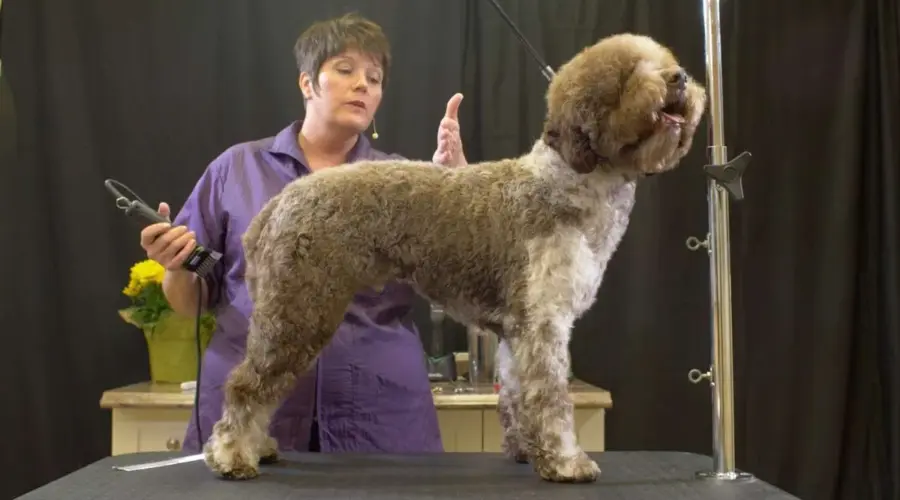
For professional grooming or a full clip, most owners find that every eight to twelve weeks works well when maintaining a shorter, more practical coat. If you prefer a longer, more natural look, professional appointments every six to eight weeks are more realistic to prevent the coat from becoming unmanageable.
The Lagotto does not need to look like a show dog. In fact, the breed standard intentionally calls for a rustic, natural appearance. Do not feel pressured to achieve a perfectly uniform clip. Keeping the coat clean, mat-free, and at a comfortable length is the goal.
Tools You Actually Need
You do not need a professional grooming setup to maintain a Lagotto at home, but a few quality tools make a significant difference.
A slicker brush with fine, flexible pins is your primary tool for everyday brushing. It gets into the curls without damaging them and pulls out trapped debris effectively. Do not use a regular paddle brush or a bristle brush on a Lagotto coat. Neither will penetrate deeply enough to be useful.
A metal wide-tooth comb is essential for checking your work. After brushing, run the comb through the coat in sections. If it glides through without catching, you are mat-free. If it catches, you have more work to do with the slicker brush before you clip anything.
A detangling spray helps when you encounter small mats or tight areas. Spray lightly, work from the tips inward with your fingers, and then follow with the slicker brush. Never pull a mat from the root outward. That is painful for the dog and often makes the mat worse.
For clipping at home, a quality pair of professional-grade clippers with a number four or number five blade gives you a safe, comfortable length for most of the body. Scissors with rounded tips are useful for finishing around the face, ears, and paws.
Step-by-Step Home Grooming Routine
Start with a thorough brush-out before bathing. Water tightens the curls and makes mats significantly harder to remove. Brush the entire coat section by section, working from the legs upward and from the tail toward the head. Pay special attention to the areas behind the ears, under the armpits, around the collar line, and between the hind legs. These are the spots where mats form first and fastest.
Once the coat is fully brushed out and mat-free, you can bathe your Lagotto. Use a dog shampoo formulated for curly or woolly coats. Work the shampoo in gently and rinse thoroughly. Incomplete rinsing is one of the most common causes of skin irritation in Lagottos.
Dry the coat completely before clipping. A Lagotto clipped while damp will not clip evenly and is more prone to skin irritation from the blade. Use a low-heat dryer or let the coat air dry fully in a warm environment.
When clipping, follow the natural direction of the curl and work in smooth, consistent passes. Keep the blade moving and do not press too hard against the skin. For the face, clip carefully around the eyes to ensure clear visibility. The ears should be kept relatively short on the outside to allow air circulation, which helps prevent ear infections, a common issue in drop-eared breeds.
Finish by trimming the paw pads. Hair grows between the toes on a Lagotto and can cause slipping on smooth surfaces and trap debris. Use scissors or a small trimmer to clear the pads carefully.
The Ears, Eyes, Nails, and Teeth — The Details That Matter
Ear care is genuinely important for Lagottos. Their floppy ears trap moisture and limit airflow, which creates conditions where bacteria and yeast thrive. Check the ears weekly. They should be clean and odor-free. Use a veterinarian-recommended ear cleaning solution and a cotton ball, never a cotton swab. If you notice dark discharge, a strong odor, or your dog shaking their head frequently, that is a sign of infection and requires a vet visit.
Around the eyes, keep the hair trimmed short enough that it does not touch the eye surface. Long hair around the eyes causes irritation and can lead to tear staining over time. Some Lagottos have more prominent facial hair than others, so the frequency of this trim varies.
Nails should be trimmed every three to four weeks. If you can hear your dog clicking on the floor, the nails are too long. Long nails affect posture and can cause joint discomfort over time. If you are uncomfortable trimming nails yourself, this is an easy task to add to a professional grooming appointment.
Dental hygiene is overlooked by most dog owners but matters enormously for long-term health. Brushing your Lagotto’s teeth two or three times per week with a dog-specific toothpaste keeps tartar buildup under control and prevents the need for costly dental cleanings under anesthesia.
When to Call a Professional
Home grooming handles maintenance well, but a professional groomer who knows the Lagotto coat is worth finding and keeping. Twice a year, a professional can do a thorough dematting session, a structured clip, and address any areas that are difficult to manage at home. If you are unsure about a mat that feels tight and close to the skin, always defer to a professional rather than trying to force a clipper through it.
When choosing a groomer, specifically ask if they have experience with Lagottos or similar woolly breeds like the Portuguese Water Dog or the Barbet. A groomer unfamiliar with the coat type may clip the coat too short or too aggressively, removing the woolly texture that gives the Lagotto its characteristic look.
A Note on Grooming Frequency and Your Lagotto’s Comfort
Lagottos who are groomed consistently from puppyhood are significantly easier to work with as adults. If your dog was not introduced to grooming early, patience and positive reinforcement are your best tools. Keep early sessions short, reward generously, and build the experience as something your dog associates with calm attention and treats rather than restraint and discomfort.
A well-groomed Lagotto is a comfortable Lagotto. The coat is not purely aesthetic. An unmanaged coat becomes painful when mats tighten against the skin, restricts movement, traps heat, and creates conditions for skin issues. Regular grooming is one of the most direct ways you can take care of your dog’s physical wellbeing.
If you are considering a Lagotto and wondering whether the grooming commitment fits your lifestyle, our FAQ page has more information on what day-to-day ownership looks like. And if you are ready to meet a puppy that has already been introduced to grooming from their first weeks of life, [browse our available Lagotto Romagnolo puppies] to see who is currently looking for a home.