Lagotto Romagnolo vs Portuguese Water Dog: Which Curly, Water-Loving Breed Is Right for You?
So you have fallen for the curly coat. The intelligent eyes. The sense that this dog is going to be a genuine companion, not just a pet that happens to live in your house. And now you are sitting with two browser tabs open, one for the Lagotto Romagnolo and one for the Portuguese Water Dog, wondering which one is actually meant for you.
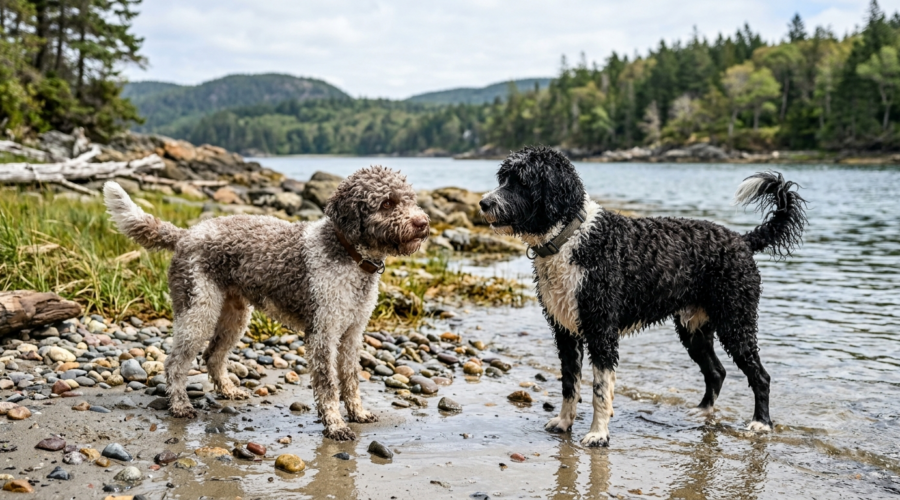
You are not the first person to end up at this crossroads. Both breeds share enough surface similarities to confuse even experienced dog people: the wavy or curly low-shedding coat, the athletic build, the working heritage built around water, the reputation for intelligence and trainability. But spend a week with each breed and you will quickly realize these two dogs are fundamentally different in ways that matter enormously for day-to-day life.
This comparison is going to be honest with you. Not a list of traits designed to make both breeds sound equally wonderful, but a real, side-by-side look at what living with each dog actually involves so you can make a decision you will feel good about five years from now.
A Quick Introduction to Each Breed
The Lagotto Romagnolo
The Lagotto Romagnolo is the oldest known water retriever in the world, originating in the marshy lowlands of the Romagna region in northeastern Italy. For centuries, these dogs worked alongside hunters in the wetlands, retrieving waterfowl with the kind of focus and nose-driven intensity that only a purpose-bred working dog possesses. When the wetlands were drained in the nineteenth century, the Lagotto transitioned seamlessly into a second career as a truffle hunter, a role it holds to this day and one that makes it the only dog breed in the world officially recognized as a truffle hunter.
The Lagotto arrived in North America relatively recently and remains one of the rarer breeds you will encounter. If you have one, you have almost certainly been stopped on walks by people who have never seen one before. Their teddy-bear appearance, curly wool-like coat, and expressive round eyes make them magnets for attention.
The Portuguese Water Dog
The Portuguese Water Dog, known affectionately by owners as the PWD or Portie, comes from the coastal regions of Portugal’s Algarve, where fishing communities bred these dogs for centuries to work alongside fishermen. Their job was demanding and varied: herding fish into nets, retrieving tackle that fell overboard, carrying messages between boats, and serving as a tireless working companion on and around the water.
The Portuguese Water Dog gained a surge of mainstream attention when the Obama family chose one named Bo as the first family dog in 2009, and their popularity has remained strong ever since. They are slightly more common in North America than the Lagotto and appear in more households, which means there is a larger community of experienced breeders and owners to learn from.
Temperament and Personality: Two Very Different Souls
This is where the comparison gets genuinely interesting, because temperament is where these two breeds diverge most significantly from each other.
The Lagotto Romagnolo: Sensitive, Thoughtful, and Deeply Connected
If you had to describe the Lagotto Romagnolo’s personality in one word, that word would probably be “attuned.” These dogs are extraordinarily sensitive to the emotional atmosphere of their household. They pick up on your stress before you have acknowledged it yourself. They mirror your mood in a way that feels almost uncanny if you have never lived with a highly empathetic breed before.
This emotional depth makes the Lagotto a remarkable companion for someone who wants a dog that feels like a genuine partner. They bond deeply with their primary person and are affectionate without being clingy in an anxious, destructive way when their relationship with you is built on a solid foundation.
Lagottos are also naturally cautious with strangers. They are not aggressive, but they are discerning. A Lagotto will take their time assessing a new person rather than immediately running up with tail wagging. Once they decide you are trustworthy, you are in for life. But that initial reserve is real, and it needs to be respected rather than forced.
The Lagotto’s truffle-hunting heritage means they are highly nose-driven. This is both a joy and a practical consideration. A Lagotto on an interesting scent can become remarkably selective about whether your recall matters to them in that moment. Solid recall training and a reliably fenced yard are non-negotiables with this breed.
The Portuguese Water Dog: Exuberant, Social, and Wired for Action
Where the Lagotto is thoughtful and measured, the Portuguese Water Dog is enthusiastic and immediate. PWDs are famously friendly, physically bold, and energetic in a way that fills a room. They tend to greet strangers with the same unbridled enthusiasm they bring to greeting their own family, which makes them wonderful dogs for social households but potentially overwhelming for families with very young children or elderly members who might be knocked over by a dog operating at full enthusiasm.
The PWD’s social openness also means they bond broadly rather than narrowly. Where a Lagotto often has one person who is clearly their person, a Portuguese Water Dog tends to be genuinely enthusiastic about everyone in the family. For families with several people who want to share the dog equally, this is a real advantage.
PWDs are energetically demanding in a way that surprises first-time owners who did not fully research the breed. This is a working dog that was bred to work all day, and the energy levels reflect that heritage. Without sufficient daily exercise, a Portuguese Water Dog will find its own entertainment, and that entertainment will involve your furniture.
Energy Levels and Exercise Needs
Lagotto Romagnolo
The Lagotto is an active, athletic dog, but it is not a high-octane exercise machine. An adult Lagotto Romagnolo does well with around forty-five minutes to an hour of physical exercise daily, supplemented by regular mental stimulation through nose work, training sessions, and puzzle toys.
What distinguishes the Lagotto from many other working breeds is that mental exercise genuinely satisfies them in a way it does not for more physically driven breeds. A thirty-minute truffle-hunting session in the yard, a nose work class, or even a good long sniff walk on a loose leash tires a Lagotto more effectively than a fast-paced run. This makes them manageable for active families who do not necessarily want to spend two hours a day on physical exercise.
The Lagotto also has an off switch. After a good exercise session, they will settle peacefully on the sofa and genuinely relax without pacing or pestering. This is a quality that owners with busy households particularly appreciate.
Portuguese Water Dog
The PWD requires more exercise than the Lagotto, and not just any exercise. This breed is built for sustained physical activity and needs real outlets for that energy every single day. An adult Portuguese Water Dog needs at least sixty to ninety minutes of vigorous exercise daily. They excel at swimming (unsurprisingly), hiking, agility, flyball, and any activity that gets them moving hard.
A PWD that has been well exercised is a delightful, manageable dog. A PWD that has been under-exercised is a different story entirely. These dogs become destructive, loud, and difficult to live with when their physical needs are consistently unmet. They do not have the same natural off switch as the Lagotto, and they will remind you with some persistence if they feel their exercise needs are being ignored.
Trainability: Smart in Different Ways
Both breeds are highly intelligent. But intelligence alone does not tell you how a dog trains, because intelligence and trainability are not the same thing.
Lagotto Romagnolo Training
The Lagotto Romagnolo is genuinely eager to work with you, and in many ways they are wonderfully responsive to positive reinforcement training. They pick up new commands quickly, they retain what they have learned, and their natural food motivation makes them attentive in training sessions.
The nuance with Lagottos is their independence. This is a breed that was developed to make decisions on its own in the field. The truffle hunter does not wait for its handler to point to every spot. It follows its nose, makes assessments, and acts accordingly. That independent thinking is magnificent in the context it was developed for. In formal obedience training, it means you occasionally have a dog that evaluates your request and decides whether it is worth complying with right now.
This is not stubbornness in a difficult sense. It is intelligence. Training that engages the Lagotto’s curiosity and rewards generosity gets outstanding results. Repetitive drilling or harsh corrections do not.
Portuguese Water Dog Training
The Portuguese Water Dog is widely considered one of the more obedience-focused working breeds, and this reputation is deserved. PWDs respond quickly to training, show strong work ethic in structured sessions, and generally comply reliably with trained behaviors even in distracting environments. Their social nature means they are strongly motivated by handler engagement and approval, which gives trainers a powerful reinforcement tool beyond food.
PWDs do require clear, consistent handling. Their energy and exuberance can translate into selective listening if training is not ongoing, and they can be pushy or demanding if boundaries are not clearly maintained. But for owners who want a dog that takes formal training seriously, the PWD’s drive and focus are genuine assets.
Grooming: Similar Coats, Different Requirements
This is one area where the two breeds appear more similar than they actually are in practice.
Lagotto Romagnolo Grooming
The Lagotto’s coat is a dense, wooly, curly or wavy double coat with a texture that is often compared to the fleece of a sheep. This coat grows continuously rather than shedding in the traditional sense, which is why the Lagotto is considered one of the better options for allergy-sensitive households.
However, “low-shedding” does not mean “low-maintenance.” The Lagotto’s coat requires brushing two to three times a week to prevent matting and professional grooming or hand-stripping every three to four months. Left unattended, the coat will cord, mat, and become uncomfortable for the dog. Most Lagotto owners keep the coat in a shorter trim for manageability, but even a shorter cut needs regular brushing.
The good news is that a well-maintained Lagotto coat is genuinely beautiful and produces minimal dander. Many people with mild dog allergies find the Lagotto manageable in a way other breeds are not, though no dog is truly hypoallergenic.
Portuguese Water Dog Grooming
The Portuguese Water Dog has a single-layer coat that is wavy or tightly curled and is also non-shedding in the traditional sense. Like the Lagotto, the PWD coat grows continuously and requires professional grooming every six to eight weeks to maintain a trim.
PWD owners traditionally choose between two grooming styles: the lion cut, which leaves the face and midsection in full coat and clips the hindquarters and muzzle closely, or a working retriever trim that clips the entire body to a uniform short length. The working trim is far more practical for most pet owners.
The PWD coat is somewhat easier to maintain between professional appointments than the Lagotto’s woolier coat, as it tends to mat less aggressively. Brushing two to three times a week remains important, but the coat is generally more forgiving of irregular schedules.
Health: What to Know Before You Commit
Lagotto Romagnolo Health
The Lagotto Romagnolo is generally a healthy breed with a lifespan of fourteen to seventeen years. The most significant health considerations specific to the breed are Lagotto Storage Disease, a progressive and ultimately fatal neurological condition that responsible breeders screen for through DNA testing, Juvenile Epilepsy, which is a benign form of epilepsy that typically resolves on its own by four months of age, and hip dysplasia, which is screened through OFA or PennHIP certifications.
Any Lagotto Romagnolo puppy you consider should come with documented DNA clearances for Lagotto Storage Disease from both parents and current health certifications for hips and eyes. This is not optional due diligence. It is the minimum standard of responsible breeding.
Portuguese Water Dog Health
The Portuguese Water Dog has a similar lifespan of twelve to fifteen years and carries its own set of breed-specific health concerns. Progressive Retinal Atrophy is the most significant heritable condition, causing progressive vision loss that can lead to blindness. GM1 Gangliosidosis is a rare but serious storage disease. Hip dysplasia and juvenile dilated cardiomyopathy, a serious heart condition seen in young PWD puppies, are also screened by reputable breeders.
As with the Lagotto, proof of health testing from both parents is non-negotiable when choosing a responsible breeder.
Family Life: Who Does Better in What Home?
The Lagotto Romagnolo Is Best Suited For:
Families or individuals who want a deeply connected, emotionally attuned companion. People with mild allergies who need a low-shedding breed. Active households that can offer daily exercise and regular mental stimulation through nose work or training. Families with older children who understand calm, respectful dog interactions. People who enjoy the rare, the distinctive, and the conversation that comes with owning a breed most people have never encountered. Anyone with an interest in nose work or truffle hunting as a hobby.
The Lagotto is also an excellent choice for urban or semi-urban living, provided their exercise needs are met consistently. They do not require a large yard, though access to outdoor space for sniffing and exploring is clearly appreciated.
The Portuguese Water Dog Is Best Suited For:
Active families who exercise vigorously and want a dog that keeps up with them every step of the way. Households where everyone wants to share the dog equally, as PWDs bond with the whole family rather than one person. Families that enjoy water sports, hiking, or agility and want a canine participant. First-time dog owners who want a breed that responds well to formal training and has a clear, well-understood behavioral profile. Households with space and a reliable exercise commitment.
The PWD is less suitable for people who want a calm, settled dog that is content with moderate activity. If you want to walk an hour a day, the Lagotto is probably the better fit. If you want to run, swim, hike, and move, the PWD will thank you for it.
Side-by-Side Comparison at a Glance
| Characteristic | Lagotto Romagnolo | Portuguese Water Dog |
|---|---|---|
| Origin | Italy (Romagna region) | Portugal (Algarve coast) |
| Size | Small to medium (24 to 35 lbs) | Medium (35 to 60 lbs) |
| Coat type | Wooly, curly double coat | Wavy or curly single coat |
| Shedding | Minimal | Minimal |
| Grooming needs | High (brushing 3x/week, professional trim every 3 to 4 months) | Moderate (brushing 2 to 3x/week, professional trim every 6 to 8 weeks) |
| Energy level | Moderate | High |
| Exercise needed | 45 to 60 min/day plus mental stimulation | 60 to 90 min/day vigorous activity |
| Trainability | High with independent thinking | High with strong work ethic |
| Stranger friendliness | Reserved initially | Immediately friendly |
| Bonding style | Deep bond with primary person | Broadly social with whole family |
| Allergy friendliness | Very good | Good |
| Lifespan | 14 to 17 years | 12 to 15 years |
| Rarity | Rare in North America | More common |
| Unique skill | Truffle hunting | Water work, swimming |
The Question Nobody Asks But Everyone Should
Here is something that rarely makes it into breed comparison articles: which dog will you enjoy living with day to day, not just on the good days?
Because both of these breeds have real demands. The Lagotto will need your emotional engagement, your consistency, and your patience with a dog that has its own ideas sometimes. The Portuguese Water Dog will need your physical commitment, your exercise schedule, and your willingness to manage an exuberant, high-energy dog in a household that works for everyone.
The breed that is right for you is not the one with the longer list of impressive qualities. It is the one whose demands align with the life you actually have and the owner you honestly are.
Frequently Asked Questions
Q: Is the Lagotto Romagnolo better for apartment living than the Portuguese Water Dog? Yes, generally speaking. The Lagotto’s moderate energy level and relatively compact size make it more adaptable to apartment or urban living than the Portuguese Water Dog, provided its exercise and mental stimulation needs are consistently met. The PWD’s higher energy demands and larger size make it a better fit for homes with more space and reliable daily access to vigorous outdoor activity.
Q: Which breed is better with young children? Both breeds can do very well with children when properly socialized from puppyhood. The Lagotto’s calmer energy and smaller size make it naturally less likely to accidentally overwhelm a small child. The PWD’s exuberance and larger build require more supervision around toddlers and young children who can be knocked over. Both breeds need to be raised with children respectfully and should never be left unsupervised with very young children regardless of breed.
Q: Are Lagotto Romagnolos and Portuguese Water Dogs good for first-time dog owners? The Portuguese Water Dog tends to be slightly more accessible for first-time owners because its social nature and strong response to training create a more straightforward early experience. The Lagotto’s emotional sensitivity and independent thinking can be rewarding to experienced dog people but occasionally frustrating for owners who are not prepared for a dog that requires genuine engagement rather than just routine management. That said, a well-researched first-time owner absolutely can succeed beautifully with either breed.
Q: Which breed lives longer? The Lagotto Romagnolo has a noticeably longer average lifespan of fourteen to seventeen years compared to the Portuguese Water Dog’s twelve to fifteen years. This is worth factoring into the emotional and practical commitment you are making when you choose a breed.
Q: Can either breed be left alone for long work days? Neither breed is well suited to spending eight or more hours alone regularly. Both are social, bonded dogs that need human company and mental engagement throughout the day. If your schedule requires long daily absences, you will need a plan that includes a dog walker, doggy daycare, or a pet sitter regardless of which breed you choose. The Lagotto, as discussed separately, can be prone to separation anxiety, so solo time management is particularly important for that breed.
Ready to meet your Lagotto Romagnolo? Our puppies are raised in a family environment with early socialization, nose work introduction, and the individual attention that sets every dog up for a confident, happy life. Browse our available Lagotto Romagnolo puppies and find out whether one of them might be your perfect match.